Why Calorie Restriction After 56 Raises Cortisol, Accelerates Muscle Loss, and Increases Long-Term Healthcare Costs
Here is where our findings diverged sharply from conventional advice.
The research on sustained calorie restriction in postmenopausal women consistently shows a pattern that surprises many readers: aggressive calorie cutting often produces less waistline improvement than expected, and in a meaningful proportion of cases, none at all. Studies reviewed in Climacteric (Davis et al., 2012) and the International Journal of Obesity (Lovejoy et al., 2008) document this directly — the postmenopausal body responds to caloric restriction differently than the premenopausal body, partly because of the two mechanisms below.
There are two well-established physiological reasons for this, and both intensify after 55:
1. The Cortisol Awakening Response shifts.
Cortisol is a stress hormone that naturally rises in the early morning to help you wake up.
Research published on the cortisol awakening response has shown that in postmenopausal women, the morning cortisol peak is meaningfully elevated compared with premenopausal women. Reviews in journals such as Psychoneuroendocrinology have documented this hormonal shift, alongside its association with central fat storage.
Chronically elevated morning cortisol has been associated with increased visceral fat storage, particularly when combined with under-eating, which the body interprets as an additional stressor.
2. Sarcopenic obesity.
From the age of 50 onwards, women lose roughly 1% of their lean muscle mass per year if they don’t actively counteract it. Muscle is the body’s most metabolically active tissue. Losing it lowers your resting metabolic rate by an estimated 80–120 calories per day. So a woman who eats less but also loses muscle ends up with a slower metabolism, weaker glucose disposal, and — paradoxically — more visceral fat than when she started.
What the research actually points to is this: the women whose waistlines respond best are not the ones eating less. They are the ones eating differently — with particular attention to one specific window of the day. We’ll come to that shortly. But first, a small marker.
If “eating less” isn’t the answer, the next obvious question is: when and what. The research suggests both matter — but one of them matters far more than most women realise. And it begins with what you do in the first 90 minutes after waking.
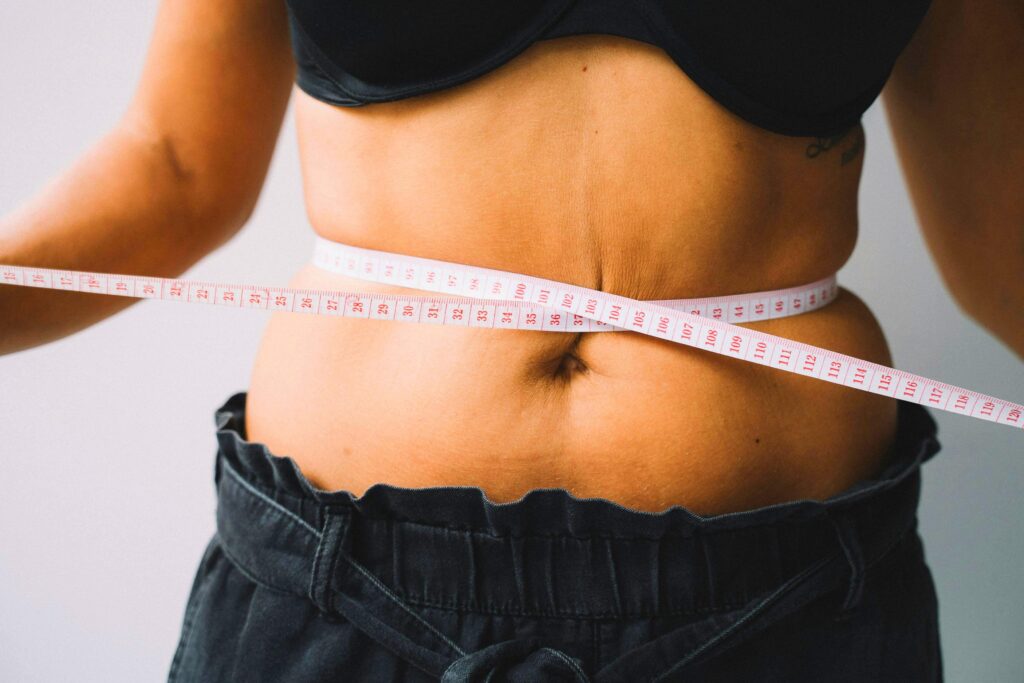
This is one reason long-term care planning experts increasingly emphasise muscle preservation in midlife: the women who maintain lean mass through their late fifties and sixties are statistically more likely to retain mobility and independence into their seventies and eighties — a factor that significantly influences both quality of life and the eventual cost of care.
Page 3 of 5